Finding China’s best Micro Switch Button supplier requires more than comparing online prices. A reliable choice begins with application details: operating force, travel distance, contact rating, terminal style, sealing level, and expected switching life. A supplier should explain these specifications clearly, not simply promise “high quality.” Small details matter. A loose terminal can stop a control panel. An inconsistent actuator can ruin an entire production batch.
OMRON founder Kazuma Tateisi expressed a useful principle: “To the machine, the human touch.” That idea remains relevant when evaluating a Micro Switch Button manufacturer. The best supplier understands how a button feels, sounds, and performs inside real equipment. Ask for samples, product drawings, test reports, and batch traceability. Examine the factory’s tooling, assembly process, inspection records, and response time. Independent certifications can support trust, but they should not replace direct verification.
Look closely.
A strong supplier will discuss failure risks honestly. They may explain contact bounce, oxidation, overload, or tolerance changes instead of hiding them. That honesty reflects professional experience. It also supports safer purchasing decisions. However, supplier selection is rarely perfect. A factory may pass an audit yet struggle with delivery consistency. A low-cost sample may perform well but fail during long-cycle testing. This is where many buyers need to reflect. Do not choose only by quotation. Compare measured performance, communication, production capacity, and after-sales responsibility. The following guide explains how to identify China’s best Micro Switch Button supplier with evidence, practical questions, and realistic quality checks.
Before choosing a China micro switch button supplier, define the application precisely. A 2024 market assessment by Mordor Intelligence estimates steady growth in the global micro switch market through 2029. That growth reflects wider use in automotive controls, appliances, industrial equipment, and compact electronics. Market demand alone does not define your component.
Record the operating details. Specify rated voltage, current, contact configuration, actuation force, travel, reset position, and expected electrical life. State whether the button receives a sharp finger press or repeated mechanical impact. A control panel near dust or water may require an IP-rated enclosure under IEC 60529.
Temperature, vibration, cable length, terminal style, and mounting space also matter. Small differences can cause field failures.
Request test evidence, not only a catalogue sheet. Ask for endurance records, contact resistance data, insulation results, and samples from the intended production line. IEC 61058-1 provides a useful reference for switches used in appliances, but your product may need additional testing. I have seen buyers test only force and appearance. That is not enough. A button can feel perfect and still fail after months of arcing or vibration. Leave room for doubt. Require traceable batch records, a clear tolerance range, and written changes to materials or tooling. Then compare suppliers against your actual duty cycle, not their most attractive specification.
Finding the best micro switch button supplier in China starts with classifying the company correctly. A factory controls production directly, while a trading company may coordinate several specialized workshops. Neither type is automatically better. The real question is visibility. Ask who molds the housing, stamps terminals, assembles contacts, and performs final testing. A capable supplier should provide process flow charts, sample records, and clear responsibility for defects.
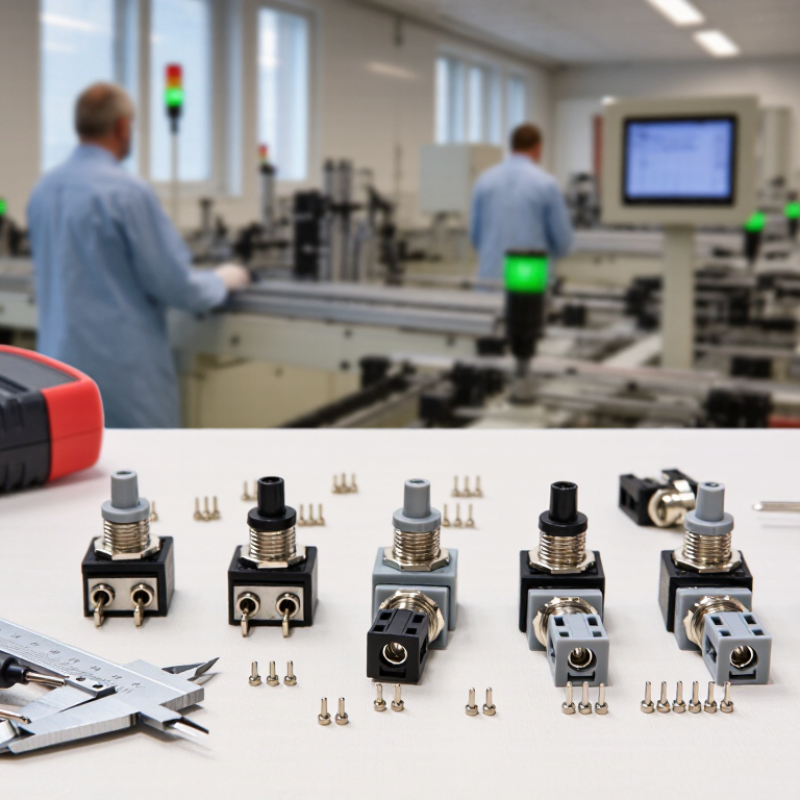
During supplier evaluations, I examine equipment, operator skills, and inspection discipline rather than showroom size. Look for injection molding machines, precision stamping presses, automated assembly, and calibrated electrical testers. Request data for contact resistance, operating force, insulation performance, and cycle-life testing. Samples should match mass-production parts, not specially polished prototypes. That difference matters. Ask for batch traceability, material certificates, change-control records, and documented corrective actions. If answers remain vague, pause.
Manufacturing experience means more than a stated number of years. Study similar switch structures, monthly capacity, tooling ownership, and experience with your required tolerances. A mature supplier can explain failure modes, such as inconsistent snap action or loose terminals. However, long experience can hide outdated equipment or slow engineering responses. I have seen impressive factories lose reliability because inspection depended on one skilled worker. That weakness deserves direct testing. Compare pilot samples, production records, and engineering-change controls before approving regular orders.
Finding China’s best micro switch button supplier requires more than comparing prices. Product quality should be verified through samples, production records, and repeat testing. Examine contact materials, actuator strength, terminal alignment, and housing finish. A reliable sample should operate smoothly after repeated presses, not only during a factory demonstration. Ask for rated electrical loads, mechanical life, operating temperature, and tolerance data. Request a batch sample, too. One sample can hide variation.
Certifications matter only when they match the actual product and target market. Check certificate numbers, issuing laboratories, expiry dates, and model references. Ask whether testing covers the exact switch configuration, not a similar series. Independent reports should identify test methods, equipment, and pass limits. Useful tests include electrical endurance, insulation resistance, contact resistance, vibration, humidity, and temperature cycling. I have seen attractive test sheets miss connector changes. That detail can affect results. Verify it carefully.
Tips: Send a written specification before requesting quotations. Include drawings, load conditions, travel distance, and expected annual volume. Compare samples from different batches. Keep photos of markings and packaging for traceability. If a supplier avoids raw test data, treat that as a warning. Still, documentation is not proof by itself. Audit the process when possible, and record every unanswered question.
Compare suppliers by verifying product quality, applicable certifications, and testing standards before placing an order.
The priority scores are a practical purchasing checklist, not certification results: 5 means the evidence should receive the highest review priority. Ask for test reports and declarations that match the exact micro switch model, rated electrical load, operating environment, and applicable standards such as IEC 61058-1, IEC 60529, IEC 60068, and RoHS.
How to Find China’s Best Micro Switch Button Supplier?
Compare pricing, customization, minimum orders, and lead times before choosing a supplier. In practical sourcing work, the lowest quote often hides tooling, packaging, testing, or replacement costs. Request a complete quotation with unit prices at different quantities. Check whether shipping, samples, and inspection fees are included. A reliable supplier should explain price changes clearly. Small details matter. Ask for recent product samples and compare their click force, terminal finish, and dimensional accuracy.
Customization needs equal attention. Confirm actuator shape, mounting holes, contact material, electrical rating, and protection requirements. Share drawings with tolerances, not only product photos. Ask whether the supplier owns suitable tooling or needs new molds. Clarify sample charges and approval procedures before mass production. A supplier with technical engineers can suggest practical changes, but suggestions should not replace your specifications.
Minimum order quantities can affect cash flow, especially during market testing. Negotiate a smaller trial order when possible, then review quality before increasing volume. Lead times should include tooling, sampling, production, inspection, and shipment. Ask for milestone dates in writing. I have seen buyers focus too much on factory capacity and overlook inspection delays. That mistake is easy to repeat. Build a reasonable buffer, and verify the supplier’s response speed when problems appear. Fast replies do not always mean dependable execution. Consistent records and transparent communication are stronger evidence.
| Supplier Profile | Typical Product Type | Indicative Unit Price (USD, FOB, 10,000 pcs) |
Standard MOQ | Customization Capability | Sample Lead Time | Mass-Production Lead Time | Typical Electrical Rating | Quality and Compliance Documents | Best Fit |
|---|---|---|---|---|---|---|---|---|---|
| Supplier Profile A High-volume manufacturer |
Sealed and snap-action micro switch buttons for appliances, automotive controls, and industrial equipment | $0.08–$0.18 | 10,000 pcs | Custom actuator, terminal, housing, contact material, cable length, and private packaging | 7–12 working days | 20–30 working days | Up to 5 A at 250 VAC; model-dependent | RoHS declaration, REACH statement, incoming-material inspection records, and routine test reports | Large recurring orders requiring competitive pricing and stable capacity |
| Supplier Profile B OEM/ODM specialist |
Panel-mount push buttons, tactile micro switches, and customized button assemblies | $0.12–$0.30 | 5,000 pcs | Strong capability for drawings, tooling, button caps, illumination, connector layout, and mechanical interfaces | 10–18 working days | 25–40 working days | Typically 1–3 A at 125/250 VAC; custom ratings require validation | RoHS, REACH, dimensional inspection reports, material certificates, and pre-production samples | Projects needing a custom housing, actuator, or integrated button assembly |
| Supplier Profile C Small-batch exporter |
Common snap-action micro switches and replacement button components | $0.15–$0.38 | 500–1,000 pcs | Limited to standard dimensions, actuator options, wire terminals, and packaging labels | 3–7 working days if stocked | 15–25 working days | Commonly 3 A at 250 VAC or 5 A at 125 VAC | Basic product specification, batch test report, and RoHS documentation when requested | Prototype runs, spare parts, maintenance orders, and low-volume testing |
| Supplier Profile D Industrial-grade producer |
High-durability micro switches for control panels, tools, sensors, and automation equipment | $0.20–$0.55 | 2,000 pcs | Custom contact plating, sealing level, force curve, operating travel, terminals, and endurance requirements | 12–20 working days | 30–45 working days | Up to 10 A at 250 VAC for selected heavy-duty models | RoHS, REACH, IP test reports where applicable, endurance test data, and process-control records | Safety-critical or high-cycle applications where reliability is more important than the lowest price |
| Supplier Profile E Trading and sourcing provider |
Standard micro switch buttons sourced from several approved factories | $0.18–$0.45 | 1,000 pcs | Packaging, labeling, basic actuator selection, and supplier coordination; limited engineering control | 5–10 working days | 20–35 working days | Depends on the selected factory and switch series | Supplier-provided specifications, pre-shipment inspection options, and compliance documents on request | Buyers needing product variety, consolidated shipments, and simplified communication |
A reliable supplier should provide real samples before any large order. Test each micro switch button for travel distance, operating force, contact stability, and reset speed. Use the parts in your actual device, not only on a desk. Cycle them repeatedly under normal conditions. Check performance after dust exposure and temperature changes. Small differences matter.
Communication often reveals production discipline. Ask for drawings, material details, tolerance ranges, and inspection records. A professional engineer should answer technical questions clearly. Replies should be timely, but speed is not everything. Watch for vague promises. Request one named contact for engineering and one for order management. Language gaps can still cause costly errors. Confirm every change in writing.
Warranty terms deserve careful reading. Check the coverage period, excluded damage, testing method, and replacement process. Ask who pays shipping for verified defects. After-sales support should include failure analysis, corrective actions, and replacement timing. A supplier that only offers discounts may not solve the real problem. I once focused too heavily on a low sample price and ignored response quality. That was a poor judgment. A stronger evaluation compares sample results, communication, warranty clarity, and support records together. Ask for evidence, not polished claims.